Best Signature Generators (2026): Top Tools for Online Document Signing
Discover the best signature generator to sign documents quickly, securely, and paper-free. Create your eSignature online and boost productivity effortlessly.


If you’re looking for the best signature generator, you’re probably not just trying to “create a signature.”
You’re trying to:
- sign documents faster
- send contracts without friction
- avoid printing, scanning, and chasing signatures
And that’s where most articles fall short—they focus on how to draw a signature, not on which tool actually fits your workflow.
This guide is different.
We tested the most popular signature generators hands-on—from simple tools to full document workflow platforms—so you can choose the right one based on how you actually work.

What Is a Signature Generator?
A signature generator is a tool that lets you generate a signature online—usually by typing, drawing, or uploading an image—and use it to sign documents online.
But in practice, most modern tools go beyond that.
They also help you:
- send documents for signature
- add fillable fields
- track signing progress
- store and reuse templates
So while the name is “signature generator,” what you’re really choosing is a document workflow tool.
Looking for simple signature creators? Check out our guide to free online signature makers.
Why Use a Signature Generator?
If you’ve ever printed a document just to sign it and scan it back—you already know the pain.
Here’s what these tools actually solve:
- Speed — sign and send documents in minutes
- Convenience — no printing, scanning, or emailing attachments back and forth
- Consistency — reuse templates instead of rebuilding documents
- Tracking — know exactly who has (or hasn’t) signed
- Paperless workflows — less clutter, fewer manual steps
Quick Answer: What’s the Best Signature Generator?
- Best overall: Fill
- Best for enterprises: DocuSign
- Best for PDF-heavy workflows: Adobe Acrobat Sign
- Best simple alternative: SignWell
- Best lightweight business tool: Signaturely
- Best for basic document workflows: Dropbox Sign
- Best for editing PDFs (not full signing workflows): Smallpdf
Best Signature Generators (Detailed Comparison)
1. Fill — Best Overall Signature Generator
Best for: Freelancers, teams, and businesses that want simplicity without sacrificing workflow power
Most tools force a trade-off:
- easy to use but limited
- or powerful but overwhelming
Fill is one of the few that actually avoids that trade-off.
From the moment you log in, it’s clear what to do next. No friction, no guessing—just upload your document and move.
But the real difference shows up when you start working with actual documents.
Key strengths
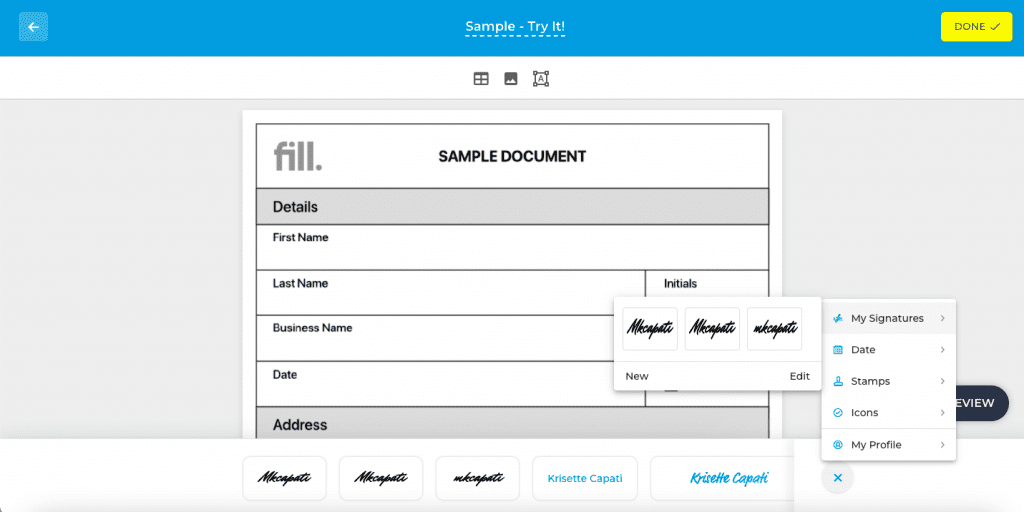
- You can pre-fill fields before sending, so recipients don’t have to repeat obvious info
- You can link fields together, which quietly saves a lot of time on longer forms
- You can sign while setting up the document—no need to reopen it later
- There’s a review step before sending, which prevents mistakes (surprisingly rare)
- Built-in form builder with conditional logic
- Strong organization with folders, tags, and templates
There are also small but meaningful touches:
- You can test the document as a recipient
- You can customize branding before sending
Limitations
- Signature timestamps can affect layout in tight document designs
- Some features (like AI assistant) require login
Verdict
If you want a tool that works immediately—but won’t break as your workflow grows—this is the most complete option here.
2. DocuSign — Best for Enterprise & Compliance
Best for: Large teams, regulated industries, high-volume contracts
DocuSign feels like enterprise software from the first click—and that’s intentional.
It’s not designed for quick one-off documents. It’s designed for structured, repeatable, compliant workflows.

Key strengths
- Advanced fields (custom validation, approvals, formulas)
- Strong audit trails and compliance features
- Real-time tracking and reporting dashboards
- Widely recognized and trusted
Once you’re inside the workflow, everything is efficient.
Limitations
- Onboarding pushes business setup before action
- No review step before sending (easy to misfire documents)
- Expensive compared to alternatives
- Can feel heavy for simple needs
Verdict
Excellent if you need compliance and scale. Too much if you just need to send and sign documents quickly.
3. Adobe Acrobat Sign — Best for PDF Workflows
Best for: Teams already working heavily with PDFs
Adobe Acrobat Sign isn’t just a signing tool—it’s part of a larger PDF ecosystem.
If your workflow is already PDF-heavy, it fits naturally. If not, it can feel like more than you need.

Key strengths
- AI-assisted detection of fillable fields (huge time saver)
- Strong integration with Adobe tools
- Reliable tracking and audit trails
- Familiar environment for existing Adobe users
Limitations
- Navigation can be confusing at first
- Higher pricing
- Limited flexibility for simple workflows
Verdict
Great if PDFs are central to your workflow. Otherwise, it can feel unnecessarily complex.
4. SignWell — Best Simple Signature Generator
Best for: Individuals or small teams who just want to send documents fast
SignWell is what you use when you don’t want to think about the tool. You just want to send something—and move on.

Key strengths
- Extremely easy to use
- Minimal interface (no clutter)
- Free plan available
Limitations
- Limited field types
- No clear way to manage saved signatures
- Some workflows feel unintuitive
Verdict
Perfect for simple needs. But once your process grows even slightly, you’ll start to feel its limits.
5. Signaturely — Best Lightweight Business Tool
Best for: Small businesses sending contracts regularly
Signaturely sits in the middle—not too simple, not too complex. It’s designed for teams that need structure, but don’t want enterprise-level friction.
Key strengths
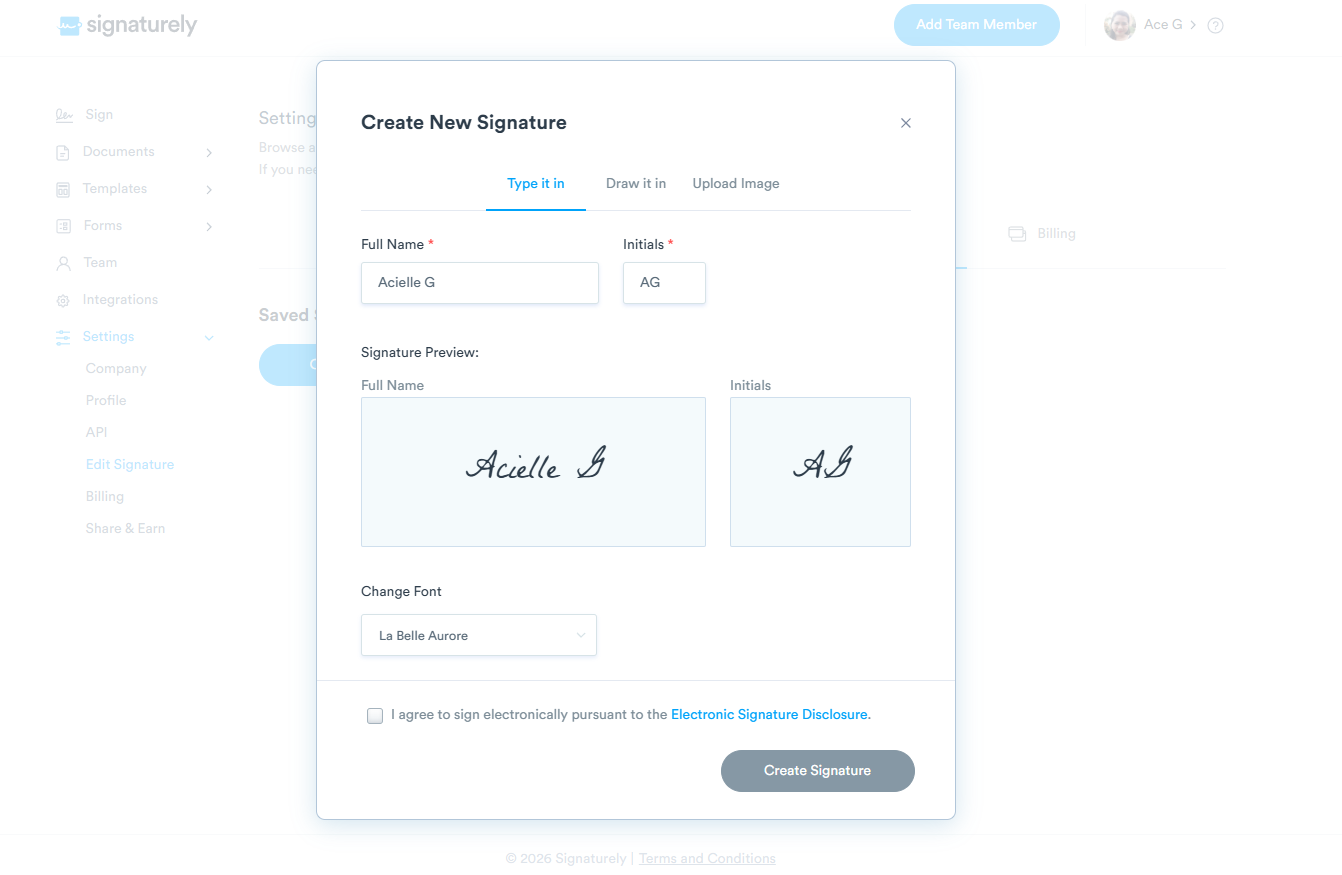
- You can fill and sign your own fields before sending
- Clean, intuitive interface
- Multiple saved signatures
Limitations
- No built-in template library
- Limited integrations
- Credit card required for trial
Verdict
A solid middle-ground option—but not the most flexible as needs grow.
6. Dropbox Sign — Best for Repeatable Workflows
Best for: Small teams handling recurring documents
Dropbox Sign feels like it was built for consistency. If you’re sending the same types of documents repeatedly, it works well.

Key strengths
- Complete set of field types (name, title, company, etc.)
- Ability to create templates directly from documents
- Helpful in-app guidance
Limitations
- Only one saved signature
- Slight friction when signing your own documents
- Limited scalability
Verdict
Great for predictable workflows. Less ideal once things get more complex.
7. Smallpdf — Best for PDF Editing (Not Workflows)
Best for: Editing PDFs and occasionally signing documents
Smallpdf is often labeled a signature generator—but it’s really a PDF editor first. And that distinction shows up quickly.

Key strengths
- Clean, visual interface
- Strong PDF editing tools
- Easy onboarding
Limitations
- No native fillable form builder
- Redirects to Sign.com for actual workflows
- Disjointed experience between tools
That split between Smallpdf and Sign.com can feel confusing if you expect everything in one place.
Verdict
Great for editing PDFs. Not ideal for managing full signing workflows.
How to Create a Signature Online
If you’ve never used a signature generator before, here’s the typical process:
- Upload your document
- Add signature and fillable fields
- Create your signature (type, draw, or upload)
- Assign fields to yourself or others
- Send the document for signing
That’s it.
Most tools follow this flow—the difference is how smooth it feels while doing it. Here's a detailed guide to creating signatures online.
How to Choose the Right Tool
Instead of asking:
“What’s the best tool?”
Ask:
“What do I actually need to do?”
- Choose Fill if you want a tool that scales with you
- Choose DocuSign / Adobe if you need compliance or enterprise workflows
- Choose SignWell if you want something simple and fast
- Choose Signaturely / Dropbox Sign for small business workflows
- Choose Smallpdf if you mainly edit PDFs

Final Thoughts
Most tools can generate a signature. That’s not the hard part.
The real difference is:
- how fast you can send documents
- how easy it is for others to sign
- how much friction you remove from your workflow
If you want a tool that balances all of that without overcomplicating things, Fill is the strongest all-around option.
Frequently Asked Questions
Are electronic signatures legally binding?
Yes. Most modern eSignature tools comply with laws like the ESIGN Act and are legally enforceable in many countries.
Can I sign PDF documents online?
Yes. Most tools support PDF signing directly, though some (like Smallpdf) separate editing and signing workflows.
Can I reuse my signature?
Yes. Most platforms allow you to save and reuse your signature across documents.
Do I need to install anything?
No. Most signature generators are web-based and work directly in your browser.